Exotic

Guideline for green fishery and Ornamental fish
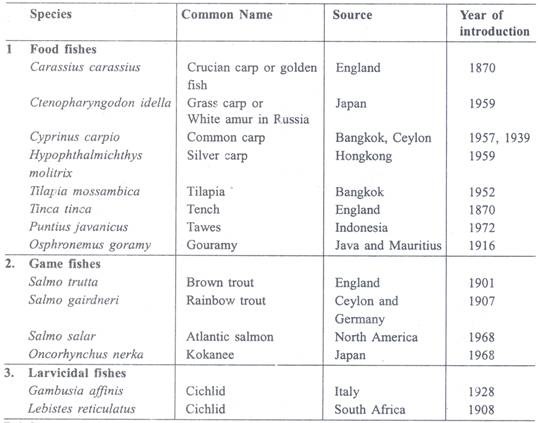
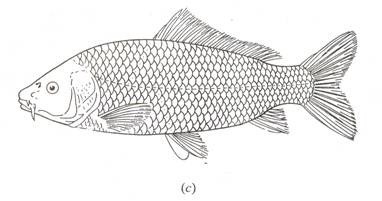
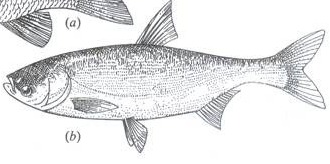
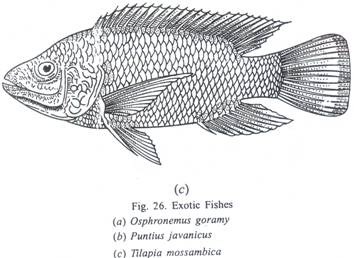
Some of the exotic fishes found in India are 1. Carassius carassius 2. Ctenopharyngodon idella 3. Cyprinus carpio 4. Hypothalmichthys molitrix 5. Tilapia mossambica 6. Puntius javanicus 7. Osphronemus gouramy

exotic fishes

India has abundant water resources in which several species of indigenous variety of fishes survives successfully. Until now the fish culture in India was mainly dependent upon the culture of some of the most common Indian species like Labeo, Catla and Mrigal.

So in conclusion ...

But it has been found in recent years that the introduction of the foreign breeds of fishes to Indian fresh water ponds and reservoirs and their culture in isolated condition or in suitable combination with the Indian counter-parts yields a higher production. In this view a number of fish species have been imported from foreign countries and introduced into Indian fresh water. Since, these fish are not the natives of this country, are called as exotic fishes.

The exotic fishes have been brought to India for different purposes. On the basis of their utility, the exotic fishes have been classified into three different categories. These are – (1) Food fishes (2) Game or Sports fishes (3) Larvicidal fishes. A list of important exotic fishes along with their source and year of introduction in India is given Above
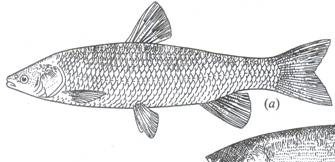
Major exotic fish

Ctenopharyngodon idella

Grass carp or white amur is a native of flat land rivers of China and the middle and lower sections of the river Amur in Russia. In India it was introduced in 1959 at Cuttack (Orissa) for the sole purpose as food fish. After the successful hypophysation at the Cuttack, in 1962 the grass carp culture started at different parts of India and a gift consignment of grass carp fry was send to Philipines, Nepal and Burma in subsequent years.

Tilapia mossambica

It is commonly called as tilapia. Tilapia is a native of rivers on the East coast of Africa. The fish is being cultured in both fresh-water as well as in brakish water ponds. The first consignment of Tilapia was brought to India in August 1952 from Bangkok and was introduced in Mandapam. The fish is very hardy with rapid growth rate.

Cyprinus carpio

Cyprinus carpio, which is commonly called as “common carp” is a native of temperate Asia but now it has a world-wide distribution. It was initially, imported in 1939 from then Ceylone and was transplanted in Nilgiri. However, another variety (scale carp) was brought from Bangkok to Cuttack (Orissa) in 1957. In India, it is being cultivated for quit long, either, singly or along with other Indian major carps. The fish has considerable food value. The fish is ideal for culture in both cold and warm water of India however the optimal water temperature ranges between 20 – 25°C.

Hypothalmichthys molitrix

It is commonly called as “silver carp”. This exotic species is a natural inhabitant of Amur basins of Russia and river systems of China. Its culture is extensively practiced in China, Thailand, Taiwan, Malaysia, Japan, Sri Lanka, Russia and now in India, Pakistan, Nepal and Philippines. Owing to its rapid growth and valued flesh, the fish is becoming popular in many parts of the world. In India, for the first time 360 fingerlings of silver carp was brought from Hongkong in 1959 to the pond culture division of CIFRI, Cuttack, Orissa. These fingerlings were cultured and successfully bred by induced breeding techniques to raise the population.